Are You Leaving Money on the Table in Your Cattle Business?
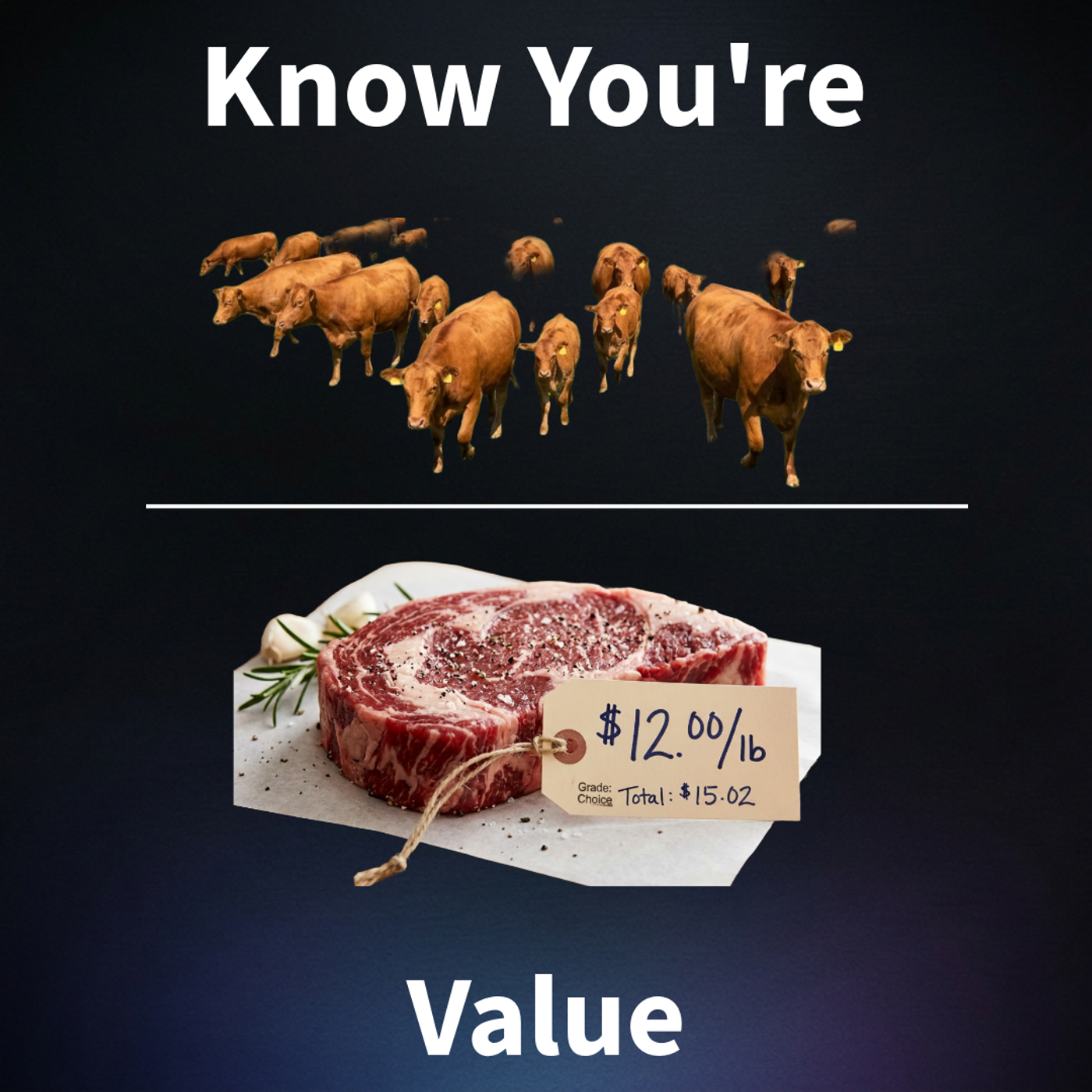
- Published
- Duration
- 43:10
How cow-calf producers can use vertical integration principles to capture more value from their own cattle — with Jojo Corrales of HeartBrand Beef.
Most cow-calf producers sell at weaning and walk away. But the genetics you invested in are worth far more down the supply chain — and without a strategy for retaining that value, you never see it. In this episode of the Cattle Innovation Station podcast, Baxter Whitworth sits down with Jojo Corrales, Vice President of Cattle Operations at HeartBrand Beef, to break down how cow-calf producers can begin capturing more of what their cattle are actually worth.
You'll learn why selling beef direct is harder than it looks and how to build a market that can move a whole carcass profitably, how HeartBrand uses individual carcass data from over 250,000 head to drive better breeding decisions, why retaining ownership through a buyback program or feedlot partnership is the only way to capture the full value of premium genetics, and why mastering your cow-calf operation has to come before integrating into other sectors.
If you're a cow-calf producer wondering whether there's more money to be made beyond the sale barn, this episode gives you an honest look at what it actually takes.
New episodes monthly. Subscribe on Apple Podcasts, Spotify, YouTube, and iHeart Radio.
Topics covered: vertical integration cattle, retaining cattle ownership, direct beef sales, cattle carcass data, cow-calf profitability, cattle genetics selection, beef cattle market versatility, source verified beef, cattle business strategy, HeartBrand Beef, Akaushi cattle, cattle industry cash flow, Cattle Innovation Station.
What is vertical integration in the cattle industry? Vertical integration in cattle means owning or controlling multiple stages of production — from cow-calf through feedlot, harvest, and beef sales. Most cattle operations are highly segregated, meaning producers rarely capture value beyond the stage they operate in. Selective vertical integration allows cow-calf producers to capture premiums they currently leave on the table.
How can a small cow-calf producer start selling beef direct? Start small — two to three head per week — and build your customer base before scaling. The real challenge isn't selling premium cuts like ribeyes and filets. It's moving the 400 pounds of ground beef per carcass at a profitable price. Build relationships with restaurants, butcher shops, and farmers market customers who can absorb different cuts before expanding your harvest numbers.
How does carcass data improve cattle genetics decisions? When producers retain ownership through harvest they receive individual carcass data — marbling scores, yield grades, efficiency, and health records — traceable back to specific sires and dams. Over time this reveals which matings produce the most profitable cattle, allowing more precise breeding decisions than EPDs alone provide.
Should I start selling direct beef or focus on my cow-calf operation first? Master your cow-calf operation first. As Jojo Corrales puts it — get good at cow-calf, then integrate. Adding direct beef sales or feedlot retention before you've mastered production adds complexity and financial risk on top of an already challenging business. Ask yourself honestly: do you like selling and talking to customers, or do you prefer raising cattle and collecting a check? Your answer should shape your integration strategy.
Baxter: Thank you for listening to this episode of the Cattle Innovation Station podcast. If you got something from this episode, make sure to share it with somebody else so that they can gain the knowledge that you have as well. And also make sure that if you're on YouTube, you like this episode and if you're on an audio platform that you rate this podcast. Thank you for listening. Until next time, keep innovating the cattle industry. Signing off. It's time for another episode of the Cattle Innovation Station podcast. I'm your host, Bexter Whitworth. And today we're going to be talking about how vertical integration, using parts of vertical integration can benefit your herd. Now, if you're wondering, why are we talking about vertical integration? I didn't think that was a good thing. There are a lot of ways that it can be used ⁓ not benefit people and take away opportunities.
Baxter Whitworth: we're back and I'm here Mr. Corrales. He is the vice president and head of cattle operations at Hartbrand Beef. ⁓ And we are going talk about how ⁓ using some form of integration in your herd can actually help you be more profitable. if you're just now listening to an episode from the Cattle Innovation Station podcast and you haven't before, Make sure and go listen to our most recent episode because that will help you understand how vertical integration can have some positives to it and how it's not always negative. So Mr. Corrales, in y'all's operation, can you just kind of explain how vertical integration helps you be more profitable? Yeah, I think the best place to start, Baxter, on looking at integrating
Baxter: But there are also ways that it can be used to create opportunities, not only for yourself, but for others as well. And if you're wondering how that works, make sure and go listen to our most recent episode. But if you're wanting to learn how you can further benefit your operation by using certain pieces of vertical integration, make sure to stick around for this episode.
Jo Jo Carrales: vertical integration helps you be more profitable? Yeah, think the best place to start, Baxter, on looking at integrating all the different sectors of production, and we know that the cattle business is the most segregated. ⁓ Compared to the other animal proteins, the cattle business is the most segregated from the genetic side. to the cow-calf side, to the stalker and feedlot, to the packer. There is very few that are able to maintain the ownership of that animal the whole way through. And I wanted to start with, to me, the hardest sector of that, which I don't oversee that at all in Heartbrand, is the meat sales. So selling meat, ⁓ to me, is one of the hardest sectors of vertical integration. ⁓ Because in a thousand pound carcass, ⁓ excuse me, not only do you have 50 different cuts of that animal, but if you want to run a good business in that, you need to sell all of them at the same rate, which is almost impossible. when you have, let's say you have a really good product. that you think your beef is superior to what is an option at the retail market, whether it's a butcher shop or grocery store. ⁓ Excuse me. If you think your product is better and you want to sell it at a premium, a lot of times you will be able to sell the rib-eyes and the strips and the filets for more money than the grocery store is asking for it. But are you able to sell the ground meat for more money? You might only have 20 pounds of tenderloins, a carcass, but you're gonna have about 400 pounds of ground meat per carcass. So if you work your way back of do I have an excellent market for my meat would be question number one. And is that purveyor of beef able to buy all of the beef that I can raise or only a portion of what I can raise? So the people that have done a great job of it And I'm thinking of a couple ⁓ other than Heartbrand that have used Akaushi genetics and they sell the product themselves. ⁓ 16 Peaks out of Tennessee and 2F Akaushi out of the Rio Grande Valley have done a great job and they've increased their business back. So they didn't start by killing maybe 35 head a week. They might have started by killing two head a week and selling that product. and getting into those channels that can buy more. And once the customer, the end user, sees a value in the product that they're buying, then that's when it increases. So if you have a herd of 30 or 100 head, your first year you may not be able to sell all of those in the beef, by the cut. You might start with some halves or whole carcasses. and then build up your client base and then be able to increase your harvest. So that is a great thing that you kind of mentioned off air is market versatility. So if we have some Akaushi producers that might have an outlet for them to sell their own meat, their first year they might do 10 head, then their second year they might do 20 or 30 head, and then by the third or fourth year they might be able to find an outlet for all that product. to very, ⁓ I guess, naively assume that you could sell the product for more money than the retailer right now of all of your cattle, I think is probably an underestimate of how good a meat salesman those cowboys are. And for example, putting myself, if I was in charge of selling meat, I think we'd be in pretty tough, pretty tough environment. So. You find good distributors, find good outlets of restaurants and retailers that can also sell the whole carcass. So when you get in a relationship with a butcher shop maybe, or restaurant that can have different types of product, you may not sell all your product to one restaurant. You might have a burger joint that able to take that premium product, a steakhouse that takes the middle meat. But then have a butcher shop that does the tri-tips and some of the briskets and short ribs and things like that and take other ⁓ products and add value to it like jerky or cutlets or sausage. Those things are a big area that I've learned from the Beeman family of realizing that our margins are tight in general, right? In agriculture, it's hard work, long hours and... tough margins, but we love it. And I think that's something that I'm very excited of what you're doing here and seeing all of those youngsters down here at Reliant Arena is just awesome of realizing that how many people have interest in agriculture still. But man, we got to get the good kids back into the business because it is a tough business. And it's something that We know as a beef industry, we're producing better beef than we ever have. We have a lower percent USDA select than we've ever have in your lifetime for sure. And we're selling it for more money. Global demand for beef is at an all-time high. So we got to take those positives and say, in my cow-calf operation, how can I take all those positives and generate more revenue for my ranch? And one of those ways is selling beef. People want to know where their beef comes from. They want to know how it was raised. They want to know the whole story of how we produce the most delicious, wholesome animal protein there is. But they still want a value. So if a really good choice ribeye is out there for $20 a pound. and you want to market yours for 30 or 40, you can sell your product once with a great story and great marketing, but to get a repeat buyer, you have to add value to that end user. Whether it's a restaurant, whether it's a retailer, or whether it's a mom that's buying groceries at the store, they're only gonna buy that more expensive product if it gives their family more value. And that's been our philosophy from day one is produce a higher quality, tastier, more juicy product more consistently. And that's what we try to do every day in terms of producing better genetics. And then we also 100 % have the next person in mind. So as a seed stock operator, we have roughly 3000 full blood Akushi mother cows. And we're very fortunate we've been in the top few. in Texas of selling the most seed stock ⁓ for many years. And we listen to our commercial producers. They say, we realize your beef is better. We realize that you have eight times more percent prime than the industry average. But if I don't return more revenue to that cow-calf operator, it doesn't really bring him any value. He may know the beef is going to taste better, but if his income is not better, then I really haven't helped him do anything. So I think that's something that when we look at the segregation of the cattle industry, we look at EPDs, EBVs, we look at performance data, and then the commercial producer looks at all of those beef indexes and dollar beef, and then he sells all the calves at weaning. Well, he didn't really take advantage of those, right? My experience is in Akaushi, but there's a lot of great other seed stock producers that do a great job of producing very high ⁓ indexing cattle. And if the cow-calf operator is not retaining them through the feedlot, is he really getting the value of that premium bull? And by knowing the efficiency, there's a lot of ⁓ feed test gains right now, a lot of ⁓ feed efficiency. tests and those are things that as the US has produced higher quality beef than ever, we've also done it more efficiently, which is very impressive. We're producing just as much beef, if not more, with a lot less cattle.
Baxter Whitworth: has produced higher quality beef than ever, we've also done it more efficiently, which is very impressive. We're producing just as much beef, if not more, with a lot less cattle. And critical to feed more people on less land. Absolutely.
Jo Jo Carrales: Absolutely. ⁓
Baxter Whitworth: Well, you ⁓ brought up a lot there. So there's about three things I want to really unpack from what you just said. First of all being that ⁓ you said that people want to people want to know where their food comes from and you're absolutely right people right now with you know there's a big movement the make america healthy again movement that people people want to know where their food comes from in a they want to eat healthy food and steak in beef is definitely an option for healthy food and so i think that is definitely a great point also you talked about how you can or you talked about it's if you're buying acahushi cattle the the goal is that or the benefit is that they are very high marbling and very carcass oriented cattle then you should you should be retaining ownership through a buyback program or through your own feedlot partnership to to reap the full rewards of that and so i think that also plays into whatever your specific niche is that you're good at ⁓ finding out what way of selling those cattle is going to make you the most money. And the third thing that I want to unpack is you talked about how you are getting data whenever you are harvesting those cattle, but you're also the seed stock producer that created the genetics for those cattle. this other end reaping the reward for that. So can you talk about how being able to see your profitability on the end and the genetics on the end of it, the end of those cattle's life at the end of the road at the harvesting plant in the distribution and selling those products. Can you talk about how that plays a role in your breeding decisions and
Jo Jo Carrales: at the harvesting plant and the distribution and selling those products. Can you talk about how that plays a role in completing decisions and... Yeah, absolutely. two subjects there to break down is source verified, knowing where your product comes from, ⁓ and then also using ⁓ data to improve genetics. So those are two great subjects.
Baxter Whitworth: Yeah, absolutely. Two subjects there to break down is source verified, knowing where your product comes from, ⁓ and then also using ⁓ data to improve genetics. So those are two great subjects. We have been extremely fortunate at Heartbrand to harvest, I believe right now, over 250,000 head of cattle. And we have individual carcass data on all of them. ⁓
Jo Jo Carrales: We have been extremely fortunate at Heartbrand to harvest, I believe right now, over 250,000 head of cattle, and we have individual carcass data on all of them. ⁓ And when we look at improving beef quality, we also still got to do it efficiently. it is somewhat contrary to think, you know, Heartbrand, high quality, Akooshi genetics, but as we look at groups of cattle that we've harvested from different producers that we buy those calves back, feed them out. ⁓ We're able to look at not just marbling. I think that's one of many things. We also look at our profit and loss of every lot. Health is a big deal. Death loss is a real big deal from one group to another. And that's something we can return that information back to that producer. So some producers have never fed their own cattle. And they don't know how they feed. They assume they do well because they use certain vaccines or certain genetics. But when you're able to look at a group of cattle that have been fed out and you look at those closeouts, you're able to see efficiency differences. You're able to look at growth curves differences of maybe having higher yield grades with higher quality grades. And we've got to pinpoint the harvest date on those. a set of very early maturing black angus calves versus a set of of ⁓ gelvi or semi or or something like that charlay crosses we're going to have a different end point goal on those animals to take advantage of those great genetics of the charlay and angus that have that have really improved a lot of growth so pinpointing when you're going to want to harvest them ⁓ and then when they start becoming inefficient and where your your rate of diminishing returns comes in so By having all that data, it's not just how much prime can I get. That's one of the last things that to me is the utmost importance when it comes to profitability. things like freight, things like herd health, efficiency. And we know that when cattle come in lighter, they're a little bit more efficient in converting ⁓ forage and nutrition into gain. Cattle that come in fleshier, heavier. their efficiency is going to be a little bit less. So looking at what price point, looking at how far I'm going to haul them, and then looking at what kind of my goals are and what I want to accomplish. So all that data needs to be used in your own operation. So if you do feed some out ⁓ and get them harvested, you're able to return that data not only to pair it up maybe to a mother cow, but to the specific sire. ⁓ and then realize what worked and what didn't work. So there's a lot of times where you do have great genetics and then you combine them with some others and sometimes those just ⁓ don't give you the end result that you want to, but they might do a lot of other good things well. So, give you a quick example. ⁓ We had bought ⁓ quite a bit of cattle. We had procured quite a bit of cattle from the King Ranch. They'd bought a good number of Akushi bulls. Kind of when I first started and we'd buy those calves back and those cattle grew out very well. The health on them was very well. Of course, they were right here in Texas. So my freight was was pretty efficient. So just because they didn't have as much carcass quality compared to that cow base, they still perform well in the big scope of things. So just like any operation, man, I'd recommend looking at the whole picture, not just exactly one. one little sector, everybody wants to just look at an IMF column. But man, look at the whole thing and see how did they do. And then if you change your corn price, which we know that never stays the same, but if you take your same efficiency data, your same IMF yield grade data, same death loss, and then you change the corn from $4 a bushel to $8 a bushel. Does that change what you should have done with them? And the answer is yes. I'm not saying when you sell them or keep them, but when you look at what fat cattle are, what yearlings are, what wean calves are, you look at all that information, look at what your cost to gain is, look at what freight is, and that's, in my opinion, that's what your operation needs to be looking at. And not saying every breeder, every person in the world needs to Akooshe cattle. I don't think that's the answer either. but we know it improves quality and when you have that information then you can make a decision on what do I need to do with those cattle and there's a list of questions you should ask yourself as a cow-calf operator to make yourself more efficient. ⁓
Baxter Whitworth: So this is great I love where this is going and I want to ask you so I kind of want I want to start talking about how ⁓ how to set up ⁓ a ⁓ sort of vertical integration into a herd to ⁓ make somebody more profitable. So what I want to know is is someone that can see what is at What really makes them profitable for their cattle from start to finish what makes them profitable? What selection traits are you finding to be the non-negotiable? That you are Looking for and selecting for in your herd and you bring up you bring up a good point. Yes, so ⁓ Functionality
Jo Jo Carrales: What is at, what really makes them profitable for their cattle from start to finish, what makes them profitable? What selection traits are you finding to be the non-negotiables that you are looking for and selecting for your And you bring up a good point, yes. So, functionality of your cow calf. Operation to your environment is the first and foremost so ⁓ Just in the last sentence I said we you know the whole world doesn't need to run a kushi Especially maybe on the mother cow side, so it's such an easy addition on the sire side But I recommend before you look at marketing your calves My recommendation is find a set of cows that fits your environment ⁓ find a set of forage that fits your environment, ⁓ find a calving season that fits your environment. You're not going to out-guess the market. No one ever has and I don't think we will. ⁓ So find a set of cows that fit what you want to do in your calving season and then you can change bulls. I would try to keep your cow base the same and right now times where the price is so high I mean a high growth bull to give you more pounds might be a good decision and in years where the corn is cheap and maybe the cattle are less expensive having a bull where you could sell the meat and know it's going to be higher quality maybe that would be fit. So to answer your question specifically the easiest way to find out is hindsight. And you know we don't all get it right very few times but when you look in hindsight and you say, dang it. You know, I should not have sold my calves when they were $3 a pound because now they're $5 a pound and fats are $2.50 and corn is $4.50. So when you look at it in the whole year past, then you could decide what would have done well, what would have done better. But you still have to make a decision and you got to move forward with whatever plan that is. But to answer your question of how to set that up. Can you sell the meat or not? Are you located ⁓ in the middle of nowhere and you don't have a million people within 300 miles? Or are you on the outskirts of one of these big metropolitan areas where you might have an extreme amount of demand of people that want source verified high quality beef and being able to buy it from the source? So if you're at a place, do you have a very good facility? to custom harvest your cattle. So contrary to about four or five years ago, the ability to custom harvest your cattle is right now more available than it ever has. The plants that they started building four, five, six years ago now are finished and now guess what? Cow numbers are the lowest they ever have. So all these new plants went up. Assuming more people would do this at the same time, fat cattle. went up maybe a thousand dollars a head you know something crazy like that so nothing stays the same no no commodity no price will stay the same but if you know how your cattle will perform in the other sectors of production that sets you up to try to take advantage of what your resources are yes sir well that that's
Baxter Whitworth: Maybe a thousand dollars a head, know, something crazy like that. So nothing stays the same. No, no commodity, no price will stay the same. But if you know how your cattle will perform in the other sectors of production, that sets you up to try to take advantage of what your resources are. Yes, sir. Well, that that's great because Like we said in the last episode, know, the market shifts and so having that impact is great. And also, like you said, knowing your business, knowing your resources and your area and customizing what works for your operation is very important also. So I just, want to ask, for different, different situations, if you're a seed stock. solely a seed stock producer at the moment, a cow calf producer, or maybe someone that backgrounds cattle, or I said cow calf, sorry, I meant commercial cattle. This is all kind of speaking to the cow calf producer mostly. But how can they start with a, start kind of retaining ownership or implementing? some principles of vertical integration into their operation. So you brought something up that I think we don't do a good job of as a whole is asking ourselves what do we like to do. if you had a person like yourself, are you 13 or 14? 15. And you like talking to people.
Jo Jo Carrales: or I said cow calf, sorry, meant commercial cattle. This is all kind of speaking to the cow calf producer mostly. But how can they start with a, start kind of retaining ownership or implementing some principles of vertical integration into their operation? Yeah, so you brought something up that I think we don't do a good job of as a whole, is asking ourselves, what do we like to do? So, If you had a person like yourself, are you 13 or 14? 15. And you like talking to people. Business and breeding. Yes, you like interacting and you like answering questions and you obviously have a good wherewithal of knowledge. If you had a few ice chests full of great beef at a farmer's market in the DFW Houston or San Antonio Austin, you could clean up, buddy. You could sell the heck out of meat. And you'd have a Friday, Saturday, Sunday, do some farmers markets, and you could do amazing selling product. A lot of cow-calf producers don't like that interaction. They like taking their cattle when they want to the cell barn and going to have lunch and getting a check and going home. And that's fine. But you gotta not put yourself in a scenario where you don't like what you're doing. So that's something that I think people have put themselves in. And then they try to sell bulls, seed stock, and they realize they run into so many tire kickers and so many calls and emails and text and Facebook messages that they just don't realize that they realize that they don't want to have anything to do with that. They'd rather run their commercial operation, sell truckloads of cattle, send me a picture of the weight tickets and a headcount, and they get a wire. That's what they like to do. That's what they're good at. They're really good at raising cattle. They raise great cattle, and they are not meat salesmen. And you gotta know that. But if you do like it, and there's a lot of people that I work with that I sell a lot of genetics to, that they make their living in town in another professional industry. And they like nothing more than going and looking their customer in the eye and telling them where this animal was raised, how it was raised, what went into those genetics, and they sell the beef and that end user enjoys that whole story. They enjoy knowing where their animal protein comes that they're putting in their body, and you have a customer for life. That is something that we got to ask ourselves is what do we like doing and what are we good at? And I think setting that up, I know you mentioned that, like how do you set yourself up? I think you ask yourself those questions and then you might realize, man, I probably need to stay at what I do well. ⁓ There used to be a ⁓ Dos Equis commercial with the most interesting man in the world. And are you familiar with the most interesting man in the world? I'm not. Okay. Well, he might have ⁓ taken a hiatus until maybe this past Super Bowl, but he was the most interesting man in the world and it showed commercials of him skydiving and climbing Mount Everest and a very wealthy man and had all and he drank Dos Equis. But one of his quotes was, find out what you don't do good in life and don't do it. Yeah. Do what you do well and what you like doing. Obviously I have a passion for what I do. I absolutely love it. And if I didn't, think it would be, it would be hard to, ⁓ you know, get up and go to work every day and, and, you know, be filled full of, of a dozen problems if I didn't absolutely enjoy what I do. I'm happy to.
Baxter Whitworth: Obviously I have a passion for what I do. I absolutely love it. Right. And if I didn't, I think it would be, it would be hard to, ⁓ you know, get up and go to work every day and, you know, be filled full of a dozen problems if I didn't absolutely enjoy what I do. Right, and do interviews and talk about it. I'm happy to. Right. Well, so that, I love what you're saying there because we all have, we all have skills. ⁓ And there's certain things in industry and life that we can learn that even if we're not necessarily born with, we can kind of learn. But then there's certain things where it's, you know, we're all born with gifts and sometimes that's just not your natural, not saying you can't get better at it, but someone else might be better for that job. But would you say that at least learning some principles of business? is going to be necessary especially if you're wanting to scale your operation and retain ownership or do some other principles of vertical integration. what a good transition to that. So I couldn't agree with you more. I'd love to
Jo Jo Carrales: Sometimes that's just not your natural, not saying you can't get better at it, but someone else might be better for that job. But would you say that at least learning some principles of business is going to be necessary, especially if you're wanting to scale your operation and retain ownership or do some other principles of vertical integration? Man, what a good transition to that. So I couldn't agree with you more. I loved My animal science classes, my genetics classes, animal breeding, just absolutely loved those. And then I would sleep during accounting. ⁓ So we were, I was on the livestock judging team and it was during the summer and we were running summer camps and all those judging camps that were stay in the dorms, keep us up all night. And I would sleep during accounting and my grades, my grades showed it. ⁓ And. If you would ask my two accountants that I work with every day and the owners of the company, which are extremely business driven and business majors, ⁓ that would be a huge area for improvement in my specific career is understanding the business aspect first and foremost. ⁓ Because we always think about money and income, right? That's always something in our mind of The feedlots making all the money, the packers making all the money, the grocery store is really sticking it to us. All of we thinking and all those things. But do we do the math? Do we do the math ourselves and say, man, I don't want to have anything to do with owning this many head right now and the risk that is out there with one global catastrophe. mean, people could go broke overnight in some of these things. So I agree with you that understanding the business aspect of your operation ⁓ is extremely important. And also, Baxter, a lot of cattle operations right now, very few of them make a living on cattle. Very few. A lot of people bought land and to get your ag exemption you got to have cattle on there. So that's where a lot of our cattle are being produced right now is for people that are doing it. because they like to. It's their hobby. They have a job in town. They come and work their cattle on the weekends. They go see their cattle in the evening and feed them and they absolutely love it. And without them, we don't have an American cattle industry. I mean, there's a few large ranches that have some tens of thousands of cattle, but that is very few and far between here in the U.S.
Baxter Whitworth: So I love what you just said because that's actually one of the big goals of this podcast is to help people, which obviously there's people that do that. Like you said, they like it, but they don't, they don't, they want to have another job and that is definitely okay. And like you just said, those people are still necessary to the cattle industry in the U S but then there's other people that have another job, but they They want to be profitable and they would like to ranch full time, at least when they go to retire. And so I want to know if someone's wanting to do that. Should they focus on building whatever sector, it be seed stock or commercial or whatever it is that they're in, should they focus on building out that sector that they're in first before they start trying to dabble in other sectors or retaining ownership or breeding their own seed stock or whatever it might be or should they? Get good at CalCat first, which is hard, right?
Jo Jo Carrales: building whatever sector, whether it be seed stock, commercial, whatever it is that they're in, should they focus on building out that sector that they're in first before they start trying to dabble in other sectors or retaining ownership or breeding their own seed stock? Yeah, absolutely. Yeah, you get good. get good at cow-calf first, which it's hard, right? So, I mean, I've been in the cattle business since I was eight. I sold a goat at the fair. I was fourth place and I got $800 and I bought my first cow. So I started early on and I absolutely love it. And those things are complicated, Vaxter. mean, the ⁓ herd health, all the vaccines ⁓ out there, all the ability to add new genetics into your operation, nutrition is a big deal. to try to get the most amount out of your animals. So I very much agree. I would master the sector that you're in first before you start integrating into other sectors. And that's how you learn. And you're not going to be an expert at all of them at first. I mean, I think that's something that I've been so fortunate ⁓ to be able to travel throughout the world. and see so many different operations and take every little thing that I see and try to say, does this work in our operation? And sometimes it doesn't. It doesn't. So you got to be OK with that. So just because you go to a beef symposium and you see a cool idea, it may not work in your operation. You may not have the ability to do that, like artificial insemination or embryo transfer or things like that that are great technology. If you don't have the facilities and the labor, it could be a wreck for you. it profitable or is it just a great idea? Yeah, that's a good way to look at it. Do the math and try it and if it doesn't work, like the guy says, don't do it.
Baxter Whitworth: beef symposium and you see a cool idea, it may not work in your operation. You may not have the ability to do that, like artificial insemination or embryo transfer or things like that that are great technology. If you don't have the facilities and the labor, it could be a wreck for you. Is it profitable or is it just a great idea? Yeah, that's a good way to look at it. Do the math and try it and if it doesn't work, like the guy says, don't do it. Well, I have one last question for you before we wrap out this episode. that is, going back to selecting cattle, you are creating the seed stock cattle and you are seeing the results of those seed stock matings at the end of the supply chain. So when you are selecting for breeding cattle, and terminal cattle, or selecting for calves that might be going back into your breeding herd versus cattle that will be terminal. Obviously, we are more concerned about muscle and the product with our terminal cattle, and we're more concerned with the longevity of our and the cost efficiency of our... ⁓ breeding cattle but how much of a difference do you see and do you ⁓ implement when you're breeding for those different selections? selection pressure on a seed stock operation. Yes sir. We have a very capable data manager named Callie that does a great job for heart rate and she really dives into looking at how the outcome of the phenotype of those animals are.
Jo Jo Carrales: breeding cattle, but how much of a difference do you see and do you ⁓ implement when you're breeding for those different selections? Yeah, so selection pressure on a seed stock operation. we have a very, very capable data manager named Callie that does a great job for heart brand and she really dives into looking at how the outcome of the phenotype of those animals are. Sometimes it's ⁓ profitability of selling bulls and or carcasses or productive females. And then we work our way back of how can we replicate those matings to make more of those productive cows, those high profitable bulls, those excellent carcasses. And that's something that it's time consuming and you have to be diligent to go with your data. So if. You get all your information back of your death loss, your efficiency, your rate of gain, your yield grade, your quality grade. And then you look back at your favorite cow, old show heifer, her offspring did terrible. What are you going to do about it? Yeah, that's a tough one, right? So, yeah, is she still working for you in the big scope of things? But you got to be.
Baxter Whitworth: your death loss, your efficiency, your rate of gain, your yield grade, your quality grade, and then you look back at your favorite cow, old show heifer, her offspring did terrible. What are you gonna do about it? That's a tough one, right? Is she still being profitable? Yeah, is she still working for you in the big scope of things? But you gotta be...
Jo Jo Carrales: you gotta remove your emotion if you're, if we're just straight talking about profitability. Now, if you have certain cows that are just gonna die on your place and you gotta be cool with that, that's one option. But to answer your question is yes, we look at end results and work our way back of which matings do we wanna make more of? ⁓ But it's actually way simpler than that. Our ranch managers They do a great job of keeping cows in the herd that work, that breed, that calve, that milk, that wean, and do it over and over again. Their last concern is IMF. And that's the way we want it run. We want to produce cattle that are functional, that are productive, and the marbling has been the easiest thing in the world to do ⁓ is maintain that extreme amount of marbling. So my advice to that of looking at extremes, I think breeding extremes in any one direction for any length of time is not good to me. ⁓ Whether it's growth, and Baxter, there's so many traits, the genetics are so complicated. that you're bringing things to the table that you don't even realize. Yes, you might select the high growth bull 10 years in a row and breed them back to the high growth cow to get your high EPDs to be the top 1 % of the breed. But what did you not realize? That you brought some really bad feet and legs to the table. You might have brought some bad udders, some bad docility, some bad phenotype. And so when we look at balanced functional cattle, I think you can't go wrong with having animals that produce in your environment on your resources. And if you want to change a bull or change a sire, I think that's one of the simple, simple things to do.
 Apple Podcasts
 Castbox
 Castro
 Goodpods
 Moon FM
 Overcast
 Pocket Casts
 Podbean
 Podcast Addict
 Podcast Republic
 Spotify