Vertical Integration: The Cattle Business Dirty Word?
- Published
- Duration
- 32:10
The word vertical integration makes most cow-calf producers uncomfortable — and for good reason. But what if used correctly it could actually make your operation more profitable?
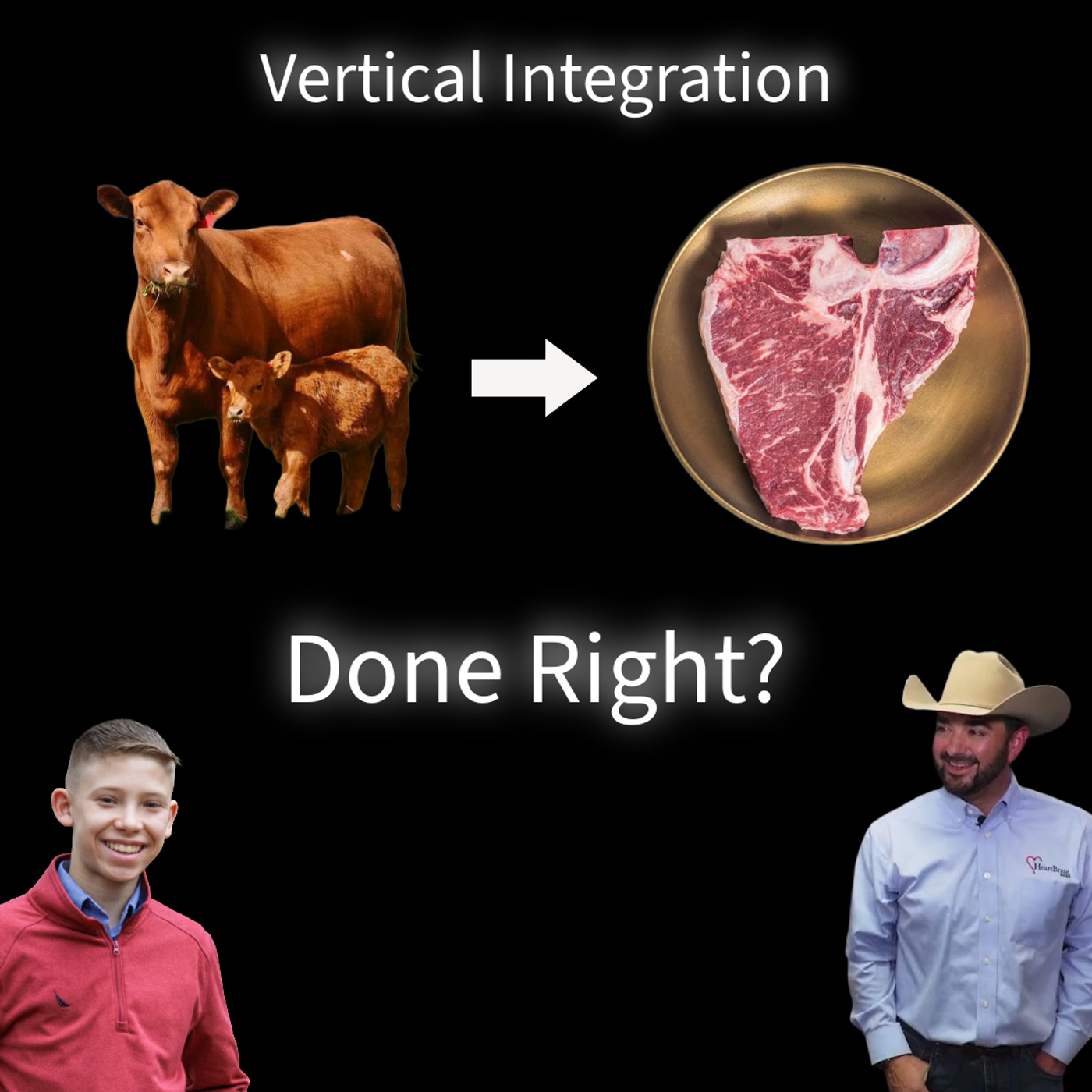
In this episode of the Cattle Innovation Station podcast, Baxter Whitworth sits down with Jojo Corrales, Vice President of Cattle Operations at HeartBrand Beef, to break down why vertical integration gets a bad reputation in the cattle industry, where that reputation is deserved, and where cow-calf producers are leaving real money on the table by ignoring it entirely.
You'll learn why the cattle industry is the most segregated animal protein sector and what that costs you, how HeartBrand uses a no-contract buyback program to create market versatility for cow-calf producers without controlling their operation, why retaining ownership and knowing your cattle's carcass performance gives you a major pricing advantage, and how to decide whether feeding out your own cattle or selling at weaning is actually the better financial decision for your operation right now.
This is not a case for handing your operation over to a packer. It's a case for understanding every option available to you — and using that knowledge to get paid more for the cattle you're already raising.
New episodes monthly. Subscribe on Apple Podcasts, Spotify, YouTube, and iHeart Radio.
Topics covered: vertical integration cattle, cow-calf profitability, cattle buyback program, retaining cattle ownership, HeartBrand Beef, Akaushi cattle, beef cattle market, cattle carcass data, cattle business strategy, cattle industry cash flow, market versatility cattle, Cattle Innovation Station.
What is vertical integration in the cattle industry? Vertical integration means owning or controlling multiple sectors of production from genetics through cow-calf, feedlot, harvest, and retail beef sales. In cattle it is far less common than in poultry or pork because of the capital, land, and time required. Most producers only operate in one sector and rarely capture value from the others.
Is vertical integration bad for cow-calf producers? Not always. The negative reputation comes from contract-based systems like poultry where producers are locked in and lose pricing power. A no-contract buyback program like HeartBrand Beef offers the opposite — a premium buyer option with no obligation to sell. That distinction is critical.
What is retaining ownership in cattle and is it worth it? Retaining ownership means keeping your cattle through the feedlot and harvest rather than selling at weaning or as yearlings. It gives you carcass data, feed efficiency data, and the potential for significantly higher returns — but requires more capital and time. Whether it is worth it depends on your genetics, location, feed costs, and cash flow needs.
How do cow-calf producers benefit from knowing their cattle's carcass data? Carcass data tied back to specific sires and dams reveals which genetics are actually producing profitable cattle versus which look good on paper. This information drives better bull selection decisions and can change what you breed for entirely.
vertical integration cattle, cow-calf profitability, cattle buyback program, retaining cattle ownership, cattle carcass data, beef cattle market versatility, cattle business strategy, Vertical integration gets a bad rap — but could it make your cattle operation more profitable? Jojo Corrales of HeartBrand Beef breaks down the real opportunity.
00:00 — Is Vertical Integration Really That Bad for Cattle Producers? 01:00 — Introduction: Jojo Corrales and HeartBrand Beef 02:30 — What Is Vertical Integration in the Cattle Industry? 04:15 — Why Cattle Is the Most Segregated Animal Protein Sector 07:55 — The Challenges of Selling Beef Direct and Moving a Whole Carcass 10:30 — Why Packers Pay More When Cattle Supply Is Tight 13:30
Baxter: Thank you for listening to this episode of the Cattle Innovation Station podcast. I hope you enjoyed the episode. I know it might be a little bit of a controversial topic, but I do hope that you listened and gained something that can help your operation be more profitable and reduce risk while you're at it. If you did get something out of this episode, please share it with somebody else so that they can gain the knowledge that you have. And until next time, keep innovating the cattle industry. Signing off.
Baxter Whitworth: Welcome back to another episode of the Cattle Innovation Station podcast. I'm your host Baxter Whitworth and today I'm joined by Mr. Jojo Corrales. He is the vice president and head of cattle operations at ⁓ Heartbrand Beef and he's going to talk to us today.
Baxter: You've probably heard the term vertical integration and you probably don't like that word for good reason. There have been many livestock and poultry producers that had been their profitability has been harmed because the they have not been able to market their livestock at a price that is beneficial to them. And I want to show you today through an interview with Mr. Jojo Corrales about how profit or how vertical integration
Baxter Whitworth: about vertical integration ⁓ and ⁓ how ⁓ vertical integration, while it can a rap for a lot of different things, we're also going to talk about the positives of it. ⁓ So Mr. Corrales, how are you today? Man, doing well today. We just got checked in with our steers, I guess, both my daughters.
Jo Jo Carrales: about vertical integration and ⁓ how ⁓ vertical integration, while it understandably get bad rap for a lot of different things, we're also going to talk about the positives of it. So Mr. Corrales, how are you today? Man, I'm doing well today. We just got checked in with our steers, I guess. ⁓ Both my daughter and son are showing ⁓ cattle here at Houston. And you're on wave as well. So worked out good. I'm happy to. ⁓ be a part of the podcast and happy to answer any questions you have on what we do at Heartbrand and any experience that I've had to kind of help your listeners identify what the positives are on vertical integration and kind of some of the complexity and hurdles as well.
Baxter: can actually help you be more profitable if you use it right and in different ways. And it will help you control the price you can sell your cattle at while being without hurting somebody else's profitability as well. So in this episode with Mr. Jojo Corrales, make sure to listen carefully and understand what's really being said.
Baxter Whitworth: positives are on vertical integration and kind of some of the complexity and hurdles as well. Yes, sir. Well, I'm definitely glad to be here doing this interview. We kind of a makeshift little studio here. So we'll I'm ready to get started. So before we jump jump into the meat of the interview, what is vertical integration? Well, I think the
Jo Jo Carrales: definitely glad to be here doing this interview. We kind of have a makeshift little studio here, so I'm ready to get started. So before we jump into the meat of the interview, what is vertical integration? Well, I think the concept of integrating different sectors of production. if you look at other animal proteins that are probably more familiar with vertical integration, like the poultry, industry, chicken and turkey, as well as pork. Most of that product that we consume here in the U.S. ⁓ is integrated of the different sectors of production, which would be the seed stock sector of producing the genetics that would go into ⁓ the meat animal production. And in the cattle side, you know, we have the cow calf, we have the stalker, ⁓ as well as the feedlot. and then the ultimate ⁓ packer and distributor. So the reason I think it's a little bit far-fetched concept is in cattle production, we are the most segregated. So, I I grew up, my dad and family had cattle, but we really never did anything after weaning. So that was something that we were told, you know, as kids that, you know, we had cows. had cows and once those calves were ready to sell, that's where we ended our relationship with them. And I really didn't have any ⁓ experience in the stalker side or in the feedlot side, much less at all in the retail beef business until I started at Heartbrand and really understood ⁓ more of those other industries. And then realized why it's not such a popular concept because there's a few things that, ⁓ we'll just go back to the poultry businesses. is you can go from an egg to a ⁓ finished product relatively quickly, as well as the pork side. So efficiency of the hog business and the poultry business, you can really get an animal ⁓ to production very quickly. And in the cattle business, when you make that breeding decision of what bull you're going to use on what cow, you're almost three years away from getting the research back on that product, whether it's good or bad. So because it is so land intensive and because it's so capital intensive and it's so segregated, that's probably the big reason why it's not so popular here in the US to have vertical integration in beef production. one of the big positives, reasons why it would be a good concept is we do think just as a natural You human instinct you always assume the next person in line is getting all the profit whether you're the seat stock guy Whether you're the cow-calf guy the stalker the feedlot or the packer or the retailer or distributor you always assume the next person's getting the better end of the deal be a bigger piece of the pie and I mean for for for centuries and decades really You know we've complained about you know the the big Packers and and they have you know bought up more packing plants and play a huge role in the beef business in the United States. But you also look at the positives of that. They can buy billions of dollars of cattle from that. And also, look at the difference of even what a fat steer's worth. I we see the floor price here at the stock shows. And from a few years ago to now, that's a completely different price. So we know that that market fluctuates. ⁓ But the packers have had to pay more money for cattle, especially more recently, because of simple supply and demand. So there's been a lot less cattle. There's been a lot more beef demand in the US. And the US has done a tremendous job of exporting a lot of beef to get value out of that carcass. There's something that's somewhere around $350 per carcass. that is generated merely from the exports. A lot of the variety meats, ⁓ heads and hides and things like tongues going to Japan and livers going to Egypt and hides going out. know, we're trying to, as a beef business in general, we're trying to generate the most amount of revenue we possibly can. ⁓ And we know that the margins are tight. So compared to other industries like oil and gas or tech, ⁓ agriculture is a tough business and I'm so excited that you're excited about the agriculture business and sharing the word, but it's still a very tough business that fewer and fewer of young people are getting involved in every year. So I think what you're doing is great and I'm happy to be a part of it and helping spread the word of just what opportunities are out there in the beef cattle production. So one of the reasons vertical integration could be an option on your cattle operation is if you know the genetics of your animal. using myself as example growing up, ⁓ you know, we switched bulls probably every couple years, went from a herfer to a semental to a brangus to an angus to a main anju and really didn't have, we had no vision of a five, 10 year plan of what are we gonna do with those offspring? You know, we sell them at weaning, but. When we looked at what we were selecting cattle for is maybe Ribeye area or IMF and we never owned them the whole way through. since I've been involved with Heartbrand, ⁓ knowing what your genetics can do gives you the tools and the versatility of marketing. So if you look at your operation and what resources you have, if you have land, if you have a cow-calf operation, If you maintain those animals through all those other sectors of production, what value is there at the end, if any? So, kind of start over a little bit on the vertical integration part is if you were in the business of raising superior genetics to improve beef quality, like we are at Heartbrand with the Akaushi genetics, we know that they marble more. It's a straight fact that the Ako-ushi cattle have more intramuscular fat. But with that specific trait, how do you take advantage of that? And in our mind is selling the meat. So we sell the meat at a premium and. So when we sell the beef at a premium, we're able to pay a premium for those finished fed cattle. And our particular brained program is a no hormone implant program. And we feel that all natural system allows the cattle to not only have more marbling, but a little more tenderness. So I know that the implant technology works. And I think for the world feeding the world beef, I think it's a great technology. But very specifically to what we do, we do a no implant. program because we are in the business of taste, tenderness, and consistency. So to get that, we feel our best option is using an extremely high marbled breed like Akaushi, crossing it on good commercial cattle that have a high milk and have high growth, and being able to feed those cattle, harvest them, and sell the meat. So in that specific program, ⁓ it definitely takes a lot of money. a lot of land and lot of time ⁓ to do that. So it's definitely not for everybody. But if you feel like you have the resources to sell beef, or if you have the resources to feed your own cattle and you know how they're going to perform, or you fed some out and see their performance, that gives you a huge advantage. I know you're in commercial steers as well, aren't you? ⁓ Yeah, so when you run those closeouts and the conversions, you can realize whether the cattle you that year Converted better or worse than the cattle you did, know before and then if you get them graded like at San Antonio and Texas cattle feeders They'll actually harvest them and show you the carcasses So it is such a benefit for the cow-calf producer to know what they're producing and if they want to change There's a lot of options to that. But if they're if their best option is to sell those cattle at yearling or at weaning That might be the best situation for them. from operation to operation, I think it changes. And then like I said before on your resources, do you have an excess amount of winter grass pasture like rye or wheat and clover? Is corn cheap? Is corn $4 a bushel or is it $8 a bushel? So once you have the wherewithal of knowing your predictability, then you can make a decision on your operation. Is it better for me? to feed them out and sell the meat? Or is it better for me to sell yearlings or sell wean calves? And if we're in a drought and like cattle prices are extremely high right now, just kind of an example of a $5 a pound, 500 pounder, you know, that if you don't sell that calf, well, you probably need to put that on the books of your opportunity cost was, you know, $2,500 at seven months. And so when you run the whole math and see if it was good or not, just like you did on your commercial closeouts, we do the same thing on our end of what can we buy those cattle for? Well, can we haul them, feed them, custom harvest them, box them, and sell the meat for? And contrary to a lot of people's belief, it is not always great to sell the beef. So when right now, fat cattle are 240, there's very little margin left for meat packers and meat sellers. So especially like getting around COVID when a lot of people were selling farm to table product and doing very well because the price was so low on finished fed cattle, it made sense to do that. If you had the wherewithal to harvest those cattle and sell the beef, the margin was there to do it. And so as fat cattle went from $1.25 to 250 a pound, That's a big number on 1,500 pounders. That's a huge difference in overall income. So yeah, my suggestion to people that we sell a lot of bulls, a lot of full-blood Akooshi bulls, around 400 a year. And my duty as a manager is ask them what their goals are. Do they want to sell wean calves that are DNA verified back to heart brand? Do they want to sell beef themselves? And then try to put them in the best scenario to make their operation succeed.
Baxter Whitworth: in overall income. yeah, my suggestion to people that we sell a lot of bulls, a lot of full-blood Akooshi bulls, around 400 a year. And my duty as a manager is ask them what their goals are. Do they want to sell wean calves that are DNA verified back to heart brand? Do they want to sell beef themselves? And then try to put them in the best scenario to make their operation succeed. well, there is a lot to unpack with with what you just said. ⁓ so let's, I want to start with something you kind of just recently said. You said that the margins right now are kind of low for the meat packers because the way the market is shifted. And so I want to talk about, because a lot of people, When they hear the word vertical integration, especially if you're on this side of the cattle industry, the side pretty much kind of the line drawn between the packers and everybody else, you a lot of times hear that word and think of the poultry industry like you mentioned earlier where it's heavily vertically integrated. And a lot of the poultry producers aren't, they don't, get very high margins at all and can barely, and the majority of them I believe are below the poverty line. So a lot of people think, rightfully so, can think ⁓ negatively when they hear that word. But can you talk about how it can be used in a positive way if managed differently to create opportunities instead of kind of controlling other people's? ⁓ operations?
Jo Jo Carrales: ⁓ Yeah, so I think there's a couple things there to definitely break down. when we think of the the big packers of Cargill, JBS, and Tyson that harvest a lot of cattle, ⁓ a lot of cattle per day and per year, ⁓ excuse me, ⁓ look at how ⁓ if one of those ⁓ companies
Baxter Whitworth: ⁓ Yeah, I think there's a couple things there to definitely break down. So when we think of the the big packers of Cargill, JBS and Tyson that harvest a lot of cattle, ⁓ a of cattle per day and per year, ⁓ excuse me, ⁓ we at how ⁓ if of those ⁓ big was wanting to become vertically integrated, ⁓ it's to be very difficult to impossible for one of one of to be vertically
Jo Jo Carrales: was wanting to become vertically integrated, it's going to be very difficult to impossible for one of one of for the to be vertically integrated in the cattle business in a big way is very, very difficult. So just think about ⁓ how many, you know, they might harvest ⁓ per day or per week and how much land they would need to have to have a cow calf operation or seed stock operation, cow calf, stalker, the whole way through. besides the time and the incredible amount of money that they would have to tie up in that project, it's almost impossible to have that much land. So when a large packing plant might harvest 5,000 head a day, the average herd size right now is about 30, isn't it? So it really does take that kind of, that structure right now. to have the demand for those calves to go into the next step and fulfill the need for beef. So a couple of positive things, the demand for beef is the highest it's ever been, which is great worldwide, which is really awesome. ⁓ But when you look at a company like Heartbrand, we're harvesting around 400 head a week, which is so minuscule in the big scope of things. But if you're gonna do that, back on the positives of that, you better be good at something. Either have very, very inexpensive cost and be able to have an outlet for the product, or you gotta have a better product. So in our mindset, and the Beeman family has had the vision of this structure and have been in the meat business for a long time, they realized to sell, to buy cattle at a premium, feed them at a higher cost, which is all natural. It's going to be about 14 to 18 percent you lose in efficiency due to that no implant, no ractopamine, ⁓ no hormone like MGA or those fed antibiotics that work. So when you lose those efficiencies, you feed them at a higher cost and then you have to custom harvest them, which is more expensive. You better sell the meat for more money. If not, that's a loss. So very simple aggumath on that. You better have a better product to sell it at a premium. because food service and retail have lots of good options to buy beef. So if you're selling beef by the pound or by the side, in my mind, you better have a better product. So the positives of that is, let's give an example this year. People are selling their calves for more money than they ever have in multi-generations. If you want to take that extra cash flow and invest it in next year's calf crop, you're able to maybe you're able to still cash flow your company, but invest in feeding in them the following year. Where in years prior, people that actually made their living off of cattle production really needed that cash flow from the sell of calves every year to survive. So there's a reason they didn't feed them out. Like, you my family, when we sold our wean calves, we need that cash to pay the lease and pay the hay bill and pay the feed bill and pay the tractor. But it takes that much extra money and that much extra time to feed them out the whole way before you do even get any carcass data. Now once you do have the carcass data, your feed data, then you can decide whether the next year that was a good decision or whether you feel like you're better off at your area, your genetics, your environment. You might be better off selling at a different point in production to suit your operation the best.
Baxter Whitworth: be better off selling at a different point in production to suit your operation the best? That's very interesting what you just talked about because what you're talking about is a great ability to be able to mitigate risk in the term of, like you said, right now the packers are losing money. a lot of times, but they're able to survive because they were making money a few years ago. And what you're saying is right now we're in a point where cow-calf producers can't are making money to be able to reinvest in their operation. And so I think it's important that people use that wisely so that they can if you know when the market goes back down, which could be a long time, but whenever it does that we'll be able to ride that ride that out. But I also want to jump back to vertical integration and you so I want to kind of clear it up for anybody that's confused that there are some negative ways that vertical integration can impact people like we talked about in the poultry industry a little bit ago but what he's talking about in the cattle industry is an ability to create opportunities like they like heart brand beef does with their buyback program which we'll talk about a little bit later but The way that they do vertical integration and you can jump in and comment here whenever you'd like, but the way they do vertical integration creates opportunities instead of control and controlling other people's operations. If the average herd size is 30 or somewhere about that, you have no selling power.
Jo Jo Carrales: But the way that they do vertical integration, and you can jump in and comment here whenever you'd like, but the way they do vertical integration, it creates opportunities instead of taking control in. No, you're absolutely right. So if the average herd size is 30 or somewhere about that, you have no selling power into a 50,000 head feedlot, and you might. have good cattle, you might have average cattle. But when you go try to price your cattle to a very large feedlot, you don't have a whole lot of power to negotiate unless you have that information of how they've performed in the past. So yes, you're exactly right. The Heartbrand buyback program is a system to allow market versatility for the cow-calf producer. It's not an obligation at all. So if you buy a full-blood Akooshi bull from Heartbrand, Let's say you buy four of them, put on a hundred head of cows. ⁓ You have the ability to sell those calves back into our cooperative system where we procure acaushi calves, feed them out and harvest them. Or if you have the wherewithal to feed them out yourself and sell the meat, we have a lot of great beef operators throughout the U.S. and throughout the world that take our genetics, improve their beef quality, and they sell the meat themselves. They know they have an ability to do that. But the whole integration and cooperative type system is merely there to offer them a premium ⁓ for raising better beef and for raising beef in a beef alliance where we can take advantage of some numbers. So it's small. I mean, we buy very, you know, some small numbers up to thousands at a time, but it does give them the opportunity to see a price, black and white, whether they want to sell into that or they want to feed them out themselves and sell as finished cattle. Those are very good options for them. And as a youngster, all the way to college, I was very intimidated by the feedlot scenario. They seem so huge, kind of like that big packer, and seem very intimidating. They're there to help. ⁓ You go tell them that you have 100 head that you want to feed. They'll also go help you. Talking about mitigating risk, they'll help you with your risk management, seeing what the futures is on when those cattle are going to be ready to sell. help you make a decision, maybe pre-buy your corn so you have a very good estimate of what your cost to gain is going to be. And then it's just a simple math equation on whether you want to ⁓ forego that cash flow and feed them. So, I mean, just the simple math of taking a 500-pounder to go to a 1500-pounder, it's going to be close to a year on a natural program. to gain about a thousand pounds in an all natural program, it's gonna take about a year. On an implanted program, it's gonna be a little bit quicker, but still, not taking that income as a cow-calf operator ⁓ the past had been a big hit. ⁓ other programs that we run also, ⁓ that'll share the risk. So if you had a hundred head of 500 pounders, but you still needed some cash to run your operation, ⁓ we could partner on those cattle. So if we agree that... $5 a pound is what they're worth. We would pay half the invoice and then we would be partners on that 100 head of cattle through the feedlot and sell them to the beef company at a premium like 30 cents over the fat market. So that's a way to take some of that income and then be able to take advantage of such a high fat market and such a good cost to gain at the moment. So there's a lot of positives to being able to do that and having a company at the end. saying yes I would like to buy those cattle at this weight, at this premium, and this is where they need to be and this is the program they need to be fed out on.
Baxter Whitworth: weight at this premium and this is where they need to be and this is the program they need to be fed out on. So you're talking about retaining ownership correct? Correct. So and that's I mean that's one part that retaining ownership is partly vertical integration and so that just kind of I think that's a great way to kind of connect a positive to some people that are listening that
Jo Jo Carrales: Correct. So, and that's, I mean, that's one part that retaining ownership is partly vertical integration. And so that just kind of
Baxter Whitworth: can understand how it can be beneficial. And of course, we're not saying that vertical integration is always a good thing. I do want to stress that. But I am grateful that we're able to of shine this light on the way that, like you said, with your buyback program, people can make money by selling you those calves back to you, or they can make money themselves by ⁓ selling their own beef. they can they have the opportunity but there's not a contract with you that's forcing them to sell. They're not obligated at all to sell the cattle. They're merely ⁓ equipping themselves with genetics that could ⁓ sell into heart brand or they can sell into another wagyu program.
Jo Jo Carrales: by selling their own beef. So they have the opportunity, but there's not a contract with you that's forcing them to sell. No, they're not obligated at all to sell the cattle. They're merely ⁓ equipping themselves with genetics that could ⁓ sell into heart brand, or they can sell into another wagyu program. But here's a quick little example like, you we always think about the the big the big bad Packers and and I'm not affiliated with with any of them But if the margins were that good, you know sell the beef yourself if it's if it's that easy and it's it's that good sell the beef yourself and 2020 2021 2022 there was a lot of people that did and did well on it. So I I think by by looking at what you have on your operation and what resources you have to do that, I think it's the best way to operate. And the really good operators do that. The really good cattle operators, they look at all their options and they talk to the professionals that kind of give them a little bit of foresight of what it's going to cost and what they're going to bring. And then they can make that decision. yeah, getting an 800 pounder right now at almost $4 a pound. Right now that might be the best option. So just by knowing that you have that option ⁓ doesn't mean it's always the best decision. And especially right now, the supply of calves and yearlings is so tight that the price is at an all time high. Amongst all the chaos going on in the world right now, price of calves are extremely high and it would take... a lot of things to go right to say, this is the exact time you need to feed them and sell the meat because there's so much opportunity elsewhere.
Baxter Whitworth: them and sell the meat because there's so much opportunity elsewhere. That's right. Well thank you.
 Apple Podcasts
 Castbox
 Castro
 Goodpods
 Moon FM
 Overcast
 Pocket Casts
 Podbean
 Podcast Addict
 Podcast Republic
 Spotify